
SpinQ's Quantum-Enhanced GLP-1 Drug Discovery Study Tracked by International Quantum Medicine Monitor
2026.11.03 · Press Release Quantum computerSuperconducting quantum computer
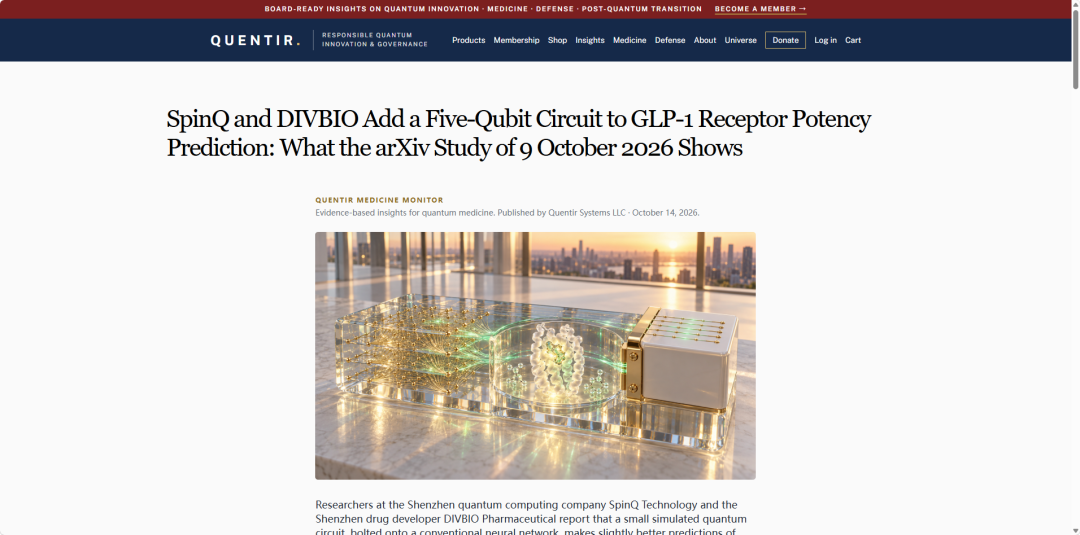
SHENZHEN,China—November 3, 2026 —A joint study from Shenzhen quantum computing company SpinQ and drug developer DIVBIO has been indexed by the Quantir Medicine Monitor, a US-based platform that tracks quantum medicine progress for boards, policymakers, and investors.
Published as an arXiv preprint on October 9, 2026 (arXiv:2610.13037), the research shows that embedding a five-qubit simulated quantum circuit into a classical neural network improves potency predictions for GLP-1 receptor candidates — a leading target for type 2 diabetes and weight-management drugs.
The team built a quantum "residual head" with just 36 trainable parameters on top of a standard classical model. The circuit, run as a PyTorch state-vector simulation on ordinary hardware, encodes molecular representations into five qubits, applies trainable rotation gates with CNOT connections, and adds its measurement results back onto the base prediction.
Using 1,052 compounds from ChEMBL v37, the quantum head reduced mean absolute error from 0.677 to 0.639 log units (fingerprint model) and from 0.680 to 0.641 (graph model) under a structure-cluster split — roughly a 6% gain, consistent across all test configurations.
A key strength of the paper is its classical control: the authors prove the quantum head computes a constrained quadratic function, then train an equivalent 36-parameter classical model that tracks the quantum head closely, suggesting part of the gain comes from structurally constrained quadratic interactions.
SpinQ has open-sourced the code, data, and trained weights on GitHub under the MIT license. Next steps include validation on independent chemical series, prospective wet-lab testing, and runs on real quantum hardware.
This is a methods result, not a drug: the model predicts single-receptor in-vitro potency under specific assay conditions.
Featured Content