
How Are Superconducting Qubits Developed in the USA?
2026.09.17 · Blog in USA Superconducting Qubit
Superconducting qubits are built through a combination of quantum circuit design, precision fabrication, cryogenic engineering, and high-speed control. For researchers working with superconducting quantum computing in the USA, understanding how these elements fit together is essential when selecting a QPU or a complete quantum computing system.
The development process does not end when a quantum chip is fabricated. Qubit performance must be measured, controlled, and integrated with the surrounding hardware before the processor can support practical quantum experiments. This is where superconducting quantum chips become part of a much larger hardware architecture.
How Are Superconducting Qubits Designed?
Superconducting qubits are built from superconducting quantum circuits centered on Josephson junctions. These circuits behave as nonlinear LC resonant circuits, while their two lowest nonlinear energy levels represent the |0⟩ and |1⟩ states used for quantum computing.
Circuit design and qubit layout
The design determines how individual qubits are arranged and coupled within a processor.
For larger systems, qubit connectivity becomes increasingly important. The SPINQ QPU C Series uses an enhanced 2D lattice topology and supports up to 100+ superconducting qubits, providing a hardware foundation for larger-scale quantum computing and quantum error correction experiments.
How Are Superconducting Qubits Fabricated and Tested?
Once the circuit design is established, fabrication turns the layout into a physical quantum chip. Precision is important at every stage because the final chip must provide stable and controllable qubit behavior.
From fabrication to packaged QPU
The process covers several closely connected stages:
-
QPU design and simulation
-
Chip fabrication
-
Packaging
-
Testing
-
Qubit characterization
SpinQ uses standardized processes for QPU design simulation, fabrication, packaging, and testing. Packaged QPUs are supplied with characterization information including resonant cavity frequency, qubit frequency, and decoherence time.
This approach makes the transition from a fabricated chip to an experimental platform more straightforward, particularly when researchers need measured device characteristics before integrating the QPU into a larger system.
Why Is Cryogenic Operation Essential for Superconducting Qubits?
Fabrication is only one part of the development process. Superconducting qubits also require a carefully controlled low-temperature environment to operate as intended.
Maintaining a stable quantum environment
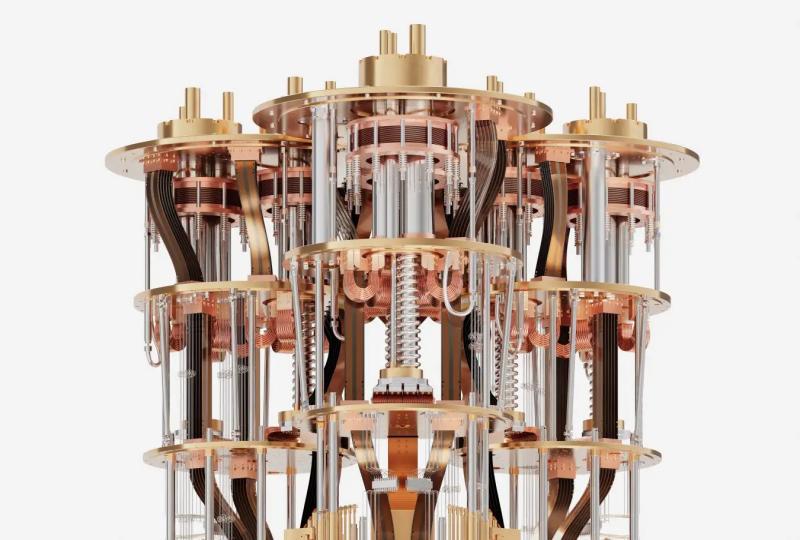
The SPINQ QPU C Series operates at ultra-low temperatures of around 20 mK and is designed for high-coherence and high-stability quantum computing applications.
A superconducting quantum computing setup therefore needs more than the chip itself. Cryogenic equipment, RF components, thermal connections, and system integration all have to work together to provide a stable operating environment.
This is why cryogenic deployment should be considered alongside QPU selection rather than treated as a separate requirement.
How Are Superconducting Qubits Controlled and Measured?
After the QPU is placed in its operating environment, precise control and measurement become the next priority.
The quantum control and measurement system from SpinQ is designed for superconducting QPUs and uses modular RF control electronics with FPGA-based hardware acceleration. The system can scale its control capabilities to hundreds of qubits.
Precision matters at the signal level
The QCM system provides sub-nanosecond synchronization accuracy and up to 16-bit vertical resolution. Its RF components support frequency ranges such as 3.0–9.8 GHz, while selected arbitrary waveform generators provide sampling rates of up to 10 GSa/s.
These capabilities allow researchers to generate, process, and measure the signals required for superconducting qubit experiments with greater control over timing, frequency, and signal quality.
Which Superconducting Qubit Metrics Matter Most?
Once the control environment is established, the next question is how to assess the QPU itself. Three practical metrics are particularly useful: coherence, gate fidelity, and qubit connectivity.
Coherence time
The SPINQ QPU C5 provides a median T₁ of at least 30 μs and T₂ of at least 15 μs. The C25 PRO provides median T₁ of at least 60 μs and T₂ of at least 30 μs.
These values describe how long quantum information can maintain coherence under the specified measurement conditions.
Gate fidelity
Gate fidelity indicates how accurately quantum operations are performed.
For the C5, the listed median single-qubit gate fidelity is at least 99.5%, while two-qubit gate fidelity is at least 96%. For the C25 PRO, the listed median values reach at least 99.8% for single-qubit gates and 99% for two-qubit gates.
Qubit connectivity
Connectivity also becomes more important as the number of qubits increases. The C5 uses a 1D chain topology, while the C25 PRO uses a 2D lattice with tunable couplers.
The choice therefore depends on the intended experiment, required qubit count, and level of system integration.
How Does a Superconducting QPU Become a Complete Quantum Computer?
A QPU provides the quantum processing core, but a complete superconducting quantum computer needs several coordinated hardware and software layers.
From QPU to complete system
The SPINQ superconducting architecture integrates:
-
Quantum chip
-
QPU
-
Milli-kelvin cryogenic system
-
Quantum control and measurement electronics
-
Quantum programming framework
The SPINQ Taurus is designed as an integrated superconducting quantum computing platform and supports up to 100+ superconducting qubits at the architecture level. Its listed S25 and S25 Pro configurations each provide 25 qubits, with a 5×5 2D lattice topology and tunable couplers.
The S25 specification includes T₁ ≥30 μs, T₂ ≥15 μs, median single-qubit gate fidelity ≥99.5%, and median two-qubit gate fidelity ≥96%. The S25 Pro increases these listed median values to T₁ ≥60 μs, T₂ ≥30 μs, single-qubit gate fidelity ≥99.8%, and two-qubit gate fidelity ≥99%.
For organizations that need an integrated platform rather than an individual QPU, this system-level approach reduces the complexity of coordinating separate hardware layers.
Which SpinQ Solution Fits Your Superconducting Qubit Project?
The right configuration depends on where the project sits in the development process.
For QPU research and validation
The SPINQ QPU C Series provides packaged superconducting QPUs in different configurations. The C5 and C25 PRO offer 5 and 25 qubits respectively, with different topologies and performance specifications.
This makes the QPU route suitable when the focus is on quantum hardware research, QPU testing, cryogenic experiments, or processor development.
For control and measurement
When the main requirement is accurate RF signal generation, qubit measurement, characterization, and calibration, the SPINQ QCM System provides a modular control architecture that can expand toward hundreds of qubits.
For a complete superconducting quantum computer
For projects that require an integrated system, SPINQ Taurus combines the QPU, control electronics, dilution refrigeration, programming framework, system deployment, and performance optimization into a turnkey superconducting quantum computing solution.
The choice is therefore straightforward: select the QPU when the priority is quantum hardware development, choose the QCM system when control and measurement are central, or adopt an integrated superconducting quantum computer when the project requires a complete research and computing platform.
Superconducting qubit development is ultimately a system engineering process. Precise chip fabrication provides the physical foundation, cryogenic engineering creates the operating environment, and accurate control and measurement turn the QPU into a usable quantum processor.
For research institutions and industrial users developing superconducting quantum computing projects in the USA, SpinQ provides QPUs, quantum control and measurement systems, and integrated superconducting quantum computing solutions to support different stages of development.
Featured Content