
How Can AI Superconducting Qubit Solutions Improve Quantum Computing?
2026.09.18 · Blog for AI Superconducting Qubit
AI applications increasingly involve complex optimization, model training, and data processing. Quantum computing offers another computational approach for selected AI workloads, while superconducting qubits provide a hardware foundation for developing quantum computing systems.
For organizations exploring AI superconducting qubit applications, the key question is how AI algorithms, quantum programming, and superconducting quantum hardware can work together. SpinQ connects these elements through AI-based quantum computing solutions, quantum programming tools, and superconducting quantum computing systems. AI-based quantum computing solutions provide a foundation for exploring the connection between artificial intelligence and quantum computing.
Where Can AI Superconducting Qubit Solutions Add Value?
Quantum machine learning for AI applications
Quantum machine learning uses quantum computing to enhance traditional artificial intelligence. Its application areas include computer vision, natural language processing, reinforcement learning, and recommender systems.
For AI superconducting qubit applications, quantum machine learning provides a way to explore how quantum computing resources can be applied to specific AI workloads. The focus is on matching suitable quantum algorithms with computational problems that can benefit from quantum processing.
Quantum-based optimization
Optimization is an important part of AI model training. When models involve multiple variables, efficient gradient computation and parameter optimization become increasingly important.
SpinQ has developed a quantum-based gradient computation method that uses quantum computing parallelism to obtain numerical gradient results for multivariate functions with one computation. This provides an approach to parameter optimization in AI-related applications.
How Does AI Superconducting Qubit Programming Support Quantum Machine Learning?
AI-based quantum applications need a programming environment that can connect algorithms with quantum computing resources.
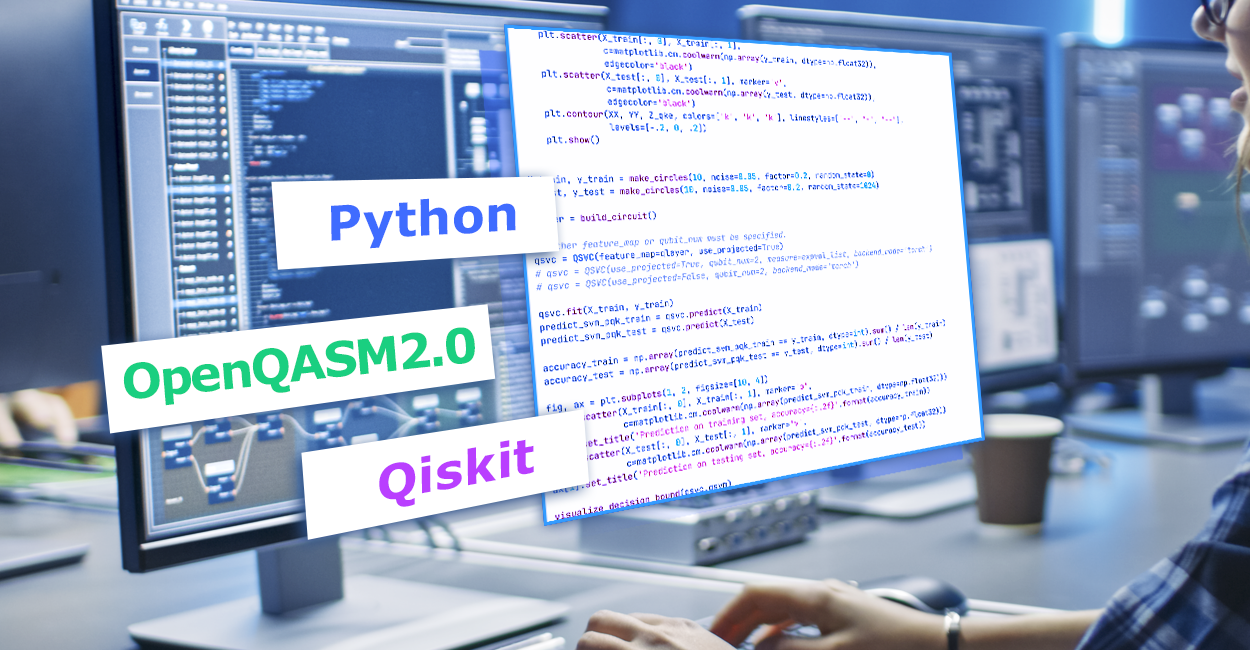
The SpinQit quantum programming framework supports Python, Open QASM 2.0, and Qiskit syntax. It also provides variational quantum algorithms and quantum machine learning algorithms for NISQ applications.
Classical and quantum computing in one workflow
AI development does not need to be separated from quantum programming. SpinQit integrates with classical machine learning frameworks including PyTorch, TensorFlow, and PaddlePaddle.
This hybrid approach allows classical machine learning methods and quantum algorithms to be combined within the same development workflow. For AI superconducting qubit projects, this creates a practical connection between classical AI development and quantum algorithm execution.
Flexible execution options
Quantum programs can be submitted to real quantum computers, quantum simulators, the SpinQ cloud, and QASM-based cloud platforms.
This allows developers to move between algorithm development, simulation, and quantum hardware execution while maintaining a consistent programming environment.
What Makes a Superconducting Qubit Suitable for AI Applications?
Superconducting quantum computing provides the hardware foundation for executing quantum algorithms at increasing scales. For AI superconducting qubit applications, the processor needs to work together with the surrounding control, measurement, and computing infrastructure.
High-fidelity quantum operations
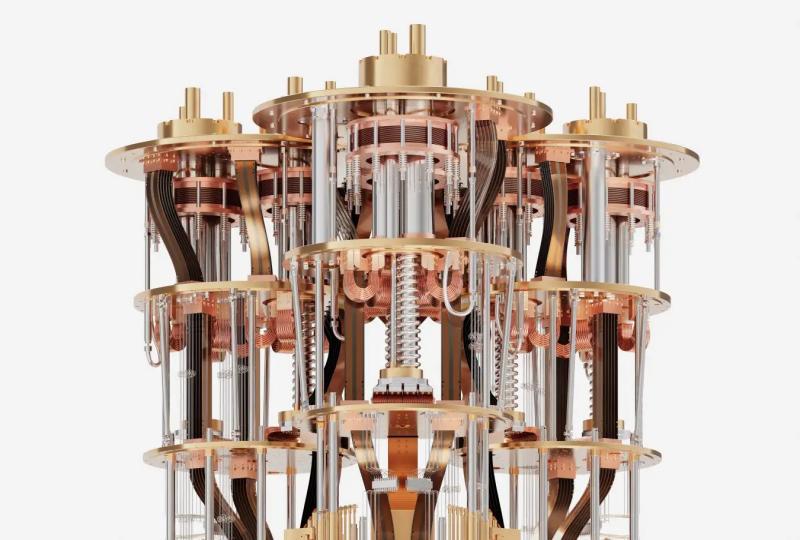
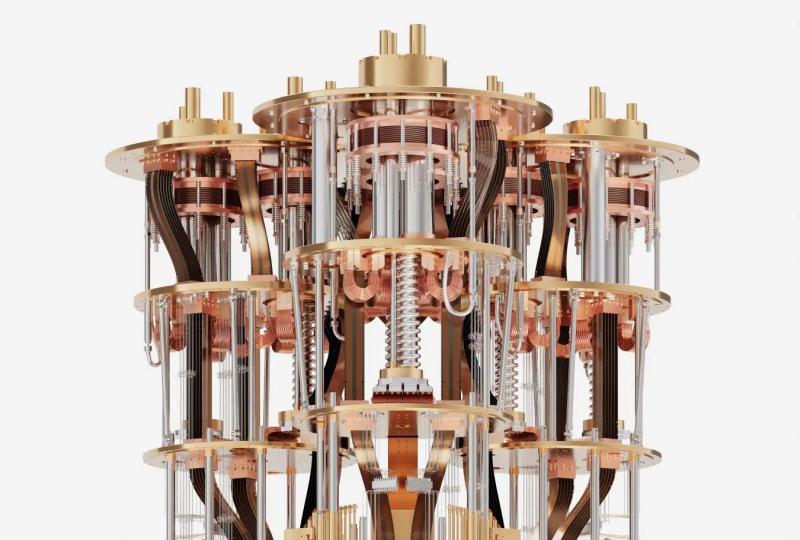
SPINQ Taurus™ uses superconducting qubits formed with circuits incorporating Josephson junctions. Its architecture is designed around scalable qubit numbers, high gate fidelity, and controllable multi-qubit coupling.
These characteristics provide a hardware foundation for research and development involving quantum algorithms and AI-related applications.
A path toward larger systems
The SPINQ Taurus™ platform supports up to 100+ superconducting qubits. Its applications include AI, materials science, biopharmaceuticals, and FinTech.
For projects requiring specific configurations, superconducting quantum computing options can be selected according to the required qubit scale and system specifications.
How Can AI-Based Solutions Be Optimized for Superconducting Qubits?
Moving a quantum algorithm from development to physical hardware requires the circuit to match the characteristics of the target quantum processor.
Hardware-aware circuit optimization
SpinQit provides multi-level compilation optimization, including redundant gate simplification, single- and two-qubit gate fusion, hardware-topology-based circuit transformation, and qubit mapping.
These capabilities help adapt quantum circuits to different execution environments and hardware configurations, which is important when developing AI superconducting qubit applications for physical quantum processors.
Simulation before hardware execution
SpinQit includes CPU and GPU quantum simulators, with features such as backpropagation and noise simulation.
For AI and quantum machine learning development, simulation provides an environment for testing quantum programs before they are executed on physical superconducting qubits.
What Hardware Supports an AI Superconducting Qubit Solution?
An AI superconducting qubit solution requires more than a quantum processor. The complete system also involves quantum control, measurement, refrigeration, and software.
An integrated superconducting architecture
The SPINQ Taurus superconducting quantum computer integrates quantum chips, control electronics, dilution refrigeration, SpinQit, system deployment, and performance optimization.
Its architecture covers quantum chip EDA design, chip fabrication, millikelvin refrigeration, quantum control, quantum measurement, and software frameworks.
This integration connects the algorithm layer with the physical infrastructure required to execute quantum programs.
.jpg)
Current S25 and S25 Pro configurations
The S25 and S25 Pro configurations each provide 25 qubits.
The S25 has T₁ ≥30 μs and T₂ ≥15 μs, while the S25 Pro has T₁ ≥60 μs and T₂ ≥30 μs. The S25 Pro provides maximum single-qubit gate fidelity of ≥99.9% and maximum two-qubit gate fidelity of ≥99.5%.
Both configurations use tunable couplers and a 5×5 2D qubit topology, with support for d=3 surface-code quantum error correction.
These specifications provide concrete reference points when selecting superconducting quantum hardware for AI-related quantum computing research.
How Can AI Superconducting Qubit Systems Scale?
AI-related quantum applications can involve increasingly complex algorithms and computational workloads. The underlying quantum platform therefore needs to support both current development and future expansion.
From algorithm development to larger quantum systems
SPINQ Taurus™ supports up to 100+ superconducting qubits. At the same time, SpinQ provides superconducting quantum computing solutions with different qubit configurations for specific research and application requirements.
This makes it possible to consider the required hardware scale according to the intended application rather than focusing on qubit count alone.
Software and hardware working together
Scalability also depends on the programming environment. SpinQit supports connections to local superconducting and NMR quantum computers, multiple quantum simulators, the SpinQ cloud platform, and third-party platforms supporting Open QASM.
This flexibility allows AI-related quantum applications to move between different development and execution environments.
What Should You Consider When Choosing an AI Superconducting Qubit Solution?
The right configuration depends on the application, algorithm, and required quantum resources.
Consider the AI algorithm
An AI superconducting qubit project may involve:
-
Quantum machine learning
-
Quantum optimization
-
AI model optimization
-
Classical-quantum hybrid algorithms
-
Complex system modeling
The programming environment should provide suitable algorithms and support the required development workflow.
Consider the superconducting hardware
For superconducting qubit applications, important specifications include:
-
Qubit count
-
Coherence time
-
Gate fidelity
-
Qubit topology
-
Coupling method
-
Quantum error correction
-
Control and measurement architecture
These specifications help determine whether the quantum system matches the intended workload.
Consider the complete solution
AI-based quantum development becomes more practical when algorithms, software, quantum processors, control electronics, cryogenic infrastructure, and measurement capabilities are considered together.
An integrated architecture provides a clearer path from AI algorithm development to execution on superconducting quantum hardware.
How Can SpinQ Support AI Superconducting Qubit Applications?
SpinQ combines AI-focused quantum computing solutions, quantum programming tools, and superconducting quantum computing hardware.
Its AI-based solution covers quantum machine learning applications including computer vision, natural language processing, reinforcement learning, and recommender systems. SpinQit provides the programming environment for quantum algorithms and classical-quantum hybrid applications, while SPINQ Taurus™ provides the superconducting quantum computing platform.
For organizations developing AI superconducting qubit applications, contact SpinQ to discuss the appropriate quantum computing configuration, software environment, and superconducting hardware requirements.
The focus is to match the quantum solution with the intended algorithm, application requirements, and development stage, creating a practical path from AI-based quantum algorithms to superconducting quantum computing.
Featured Content