
What Are China Quantum Computers and How Advancing Quantum Computing?
2026.09.15 · Blog China Quantum Computers
China quantum computers are developing across multiple hardware and system architectures, with applications ranging from quantum education and experimental research to advanced industrial computing. For organizations evaluating quantum hardware, the more important question is how each system fits a specific research or application requirement.
SpinQ develops quantum computing solutions across NMR and superconducting platforms, covering compact quantum computers, experimental systems, superconducting quantum computers, quantum chips, control and measurement systems, and related software. This range of China quantum computing solutions gives users different options based on their research objectives, system requirements, and deployment environment.
The choice therefore depends on more than qubit count. Hardware architecture, system performance, experimental access, software support, and deployment requirements all affect which China quantum computer is suitable for a particular project.
How Are China Quantum Computers Developing Today?
China quantum computing is moving across different hardware platforms, allowing quantum systems to serve different levels of research and application.
For practical users, three areas are particularly important:
-
NMR quantum computers for accessible experimentation and education
-
Superconducting quantum computers for advanced research and industrial applications
-
Quantum software and cloud platforms for programming, experimentation, and algorithm development
This range creates a practical path from quantum education and laboratory experimentation to more advanced quantum computing research.
From quantum hardware to complete systems
A quantum computer requires more than a processor to operate effectively.
Depending on the architecture, a working system can include:
-
Quantum processing units
-
Control and measurement electronics
-
Quantum programming tools
-
Experimental interfaces
-
Cryogenic infrastructure for superconducting systems
As research becomes more demanding, these components need to work together as a complete system. This makes the hardware architecture and supporting environment important considerations when selecting a quantum computer.
Which China Quantum Computing Technologies Are Available?
Different quantum computing architectures address different technical requirements. SpinQ focuses on NMR and superconducting quantum computing, providing options for both accessible quantum experimentation and higher-performance research.
NMR quantum computers
NMR technology provides a practical format for organizations that need direct access to physical quantum hardware without building a large cryogenic environment.
SpinQ's NMR portfolio includes compact 2-qubit systems and 3-qubit systems. The SPINQ Gemini Mini and Mini Pro are portable 2-qubit NMR quantum computers, while the SPINQ Triangulum II provides 3 physical qubits and supports 3-qubit quantum algorithms.
These systems are particularly useful when hands-on quantum programming, algorithm experiments, and teaching need to take place directly on real quantum hardware.
Superconducting quantum computers
For larger-scale quantum research, superconducting technology provides a different level of system capability.
The SPINQ Taurus superconducting quantum computer supports up to 100+ superconducting qubits and incorporates quantum error correction and parametric gates. Its target applications include quantum chemistry, materials science, FinTech, biopharmaceuticals, and AI.
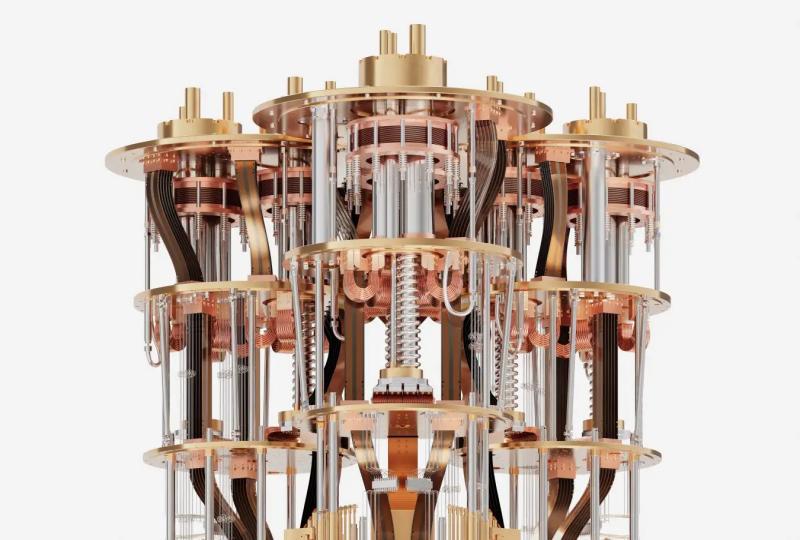
The current SQC architecture integrates superconducting QPUs, cryogenic refrigeration, and quantum control and measurement into a complete system. Recent S Series specifications reach 103 qubits, reflecting the development of larger and more integrated superconducting platforms.
What Makes China Quantum Computers Useful for Real Research?
The value of a quantum computer depends on what researchers can do with the system after deployment.
For this reason, hardware capability needs to be considered together with programming access, experimental control, and application requirements.
Direct quantum experimentation
NMR systems allow users to work directly with physical quantum states and quantum algorithms.
The SPINQ Triangulum II, for example, supports 3-qubit quantum algorithms and provides open hardware-level pulse sequence editing. This gives researchers and students greater control over quantum experiments and allows them to explore quantum computing beyond software simulation.
Advanced quantum research
Superconducting systems are designed for more demanding research where larger qubit counts, high-fidelity operations, coherence performance, and advanced control become important.
Potential research areas include:
-
Quantum chemistry
-
Molecular simulation
-
Materials research
-
Financial optimization
-
Artificial intelligence
-
Advanced quantum algorithm development
The appropriate platform depends on the scale and technical requirements of the intended research.
How Do China Quantum Computers Support Quantum Education?
Quantum education is another important application because practical experience can complement theoretical learning.
Real hardware for teaching
Compact quantum computers allow universities and research institutions to bring physical quantum experiments into teaching environments.
SpinQ's Gemini Mini and Mini Pro are 2-qubit portable NMR systems designed for quantum education, demonstrations, and self-learning. Their compact format makes it easier to introduce physical quantum computing into classrooms and training environments.
For more advanced laboratory work, a university can move toward experimental platforms that provide access to different levels of quantum computing, from pulse control to gate operations and algorithm development.
Connecting learning with research
This creates a practical progression:
Quantum education → hands-on experimentation → algorithm development → advanced quantum research
For institutions building long-term quantum programs, this progression can help align equipment investment with changing research and teaching requirements.
Which China Quantum Computer Should You Choose?
The right system depends on the intended use rather than a single specification.
For education and hands-on experimentation
A compact NMR quantum computer is suitable when portability, direct operation, and accessible quantum experimentation are priorities.
The 2-qubit Gemini series is designed for hands-on work, while the 3-qubit Triangulum II provides greater experimental flexibility and open pulse-level programming.
For university quantum laboratories
A university laboratory may require more than a desktop quantum computer.
A laboratory-oriented setup can provide access to pulse-level, gate-level, and algorithm-level experiments, making it more suitable when teaching and research need to be combined within the same experimental environment.
For advanced industrial research
When a project requires a larger quantum processor and advanced system architecture, superconducting quantum computing becomes more relevant.
The SPINQ Taurus platform supports up to 100+ superconducting qubits, with quantum error correction and parametric gates designed for advanced research and industrial applications.
How Is SpinQ Building a Practical China Quantum Computing Portfolio?
SpinQ's product development covers different stages of quantum computing deployment rather than focusing on a single hardware format.
Founded in 2018, SpinQ develops quantum computing products spanning NMR systems, superconducting quantum computers, quantum chips, software, and related technologies. Its products have been sold in more than 40 countries and regions worldwide.
Our company also became the first Chinese company to export a superconducting quantum chip overseas and the first Chinese company to deliver a superconducting quantum computer overseas. More information about SpinQ's development and product portfolio can be found in quantum computing company profile.
This broader product structure gives customers more flexibility when selecting hardware according to the actual stage and requirements of a quantum computing project.
What Should You Consider Before Buying a China Quantum Computer?
Before selecting a system, it is useful to clarify several practical requirements.
Match the hardware to the application
Consider:
-
Education or research
-
Algorithm development or hardware experimentation
-
Desktop deployment or laboratory installation
-
NMR or superconducting architecture
-
Required qubit scale
-
Programming and control requirements
-
Future expansion needs
These factors help narrow the choice between a compact NMR system, an experimental research platform, and a superconducting quantum computer.
Consider the complete operating environment
For superconducting systems, cryogenic infrastructure and quantum control are integral parts of deployment.
For NMR systems, the emphasis may instead be on accessibility, experimental flexibility, programming tools, and ease of operation.
Choosing the complete system around the research objective can therefore be more effective than selecting hardware based on qubit count alone.
Where Can China Quantum Computing Lead Next?
China quantum computing is moving toward more integrated hardware, software, control systems, and practical applications.
For research institutions and enterprises, the next stage is less about simply obtaining quantum hardware and more about creating a usable quantum computing workflow.
SpinQ continues to develop quantum hardware, superconducting systems, NMR quantum computers, quantum software, and related research applications. Readers can follow SpinQ quantum computing developments to understand new products, technologies, and application progress.
For organizations evaluating a specific deployment, the most effective approach is to define the research objective first and then match the required quantum architecture, system scale, control capability, and software environment.
If you are evaluating a China quantum computer for education, research, or industrial applications, you can discuss your requirements through quantum computing consultation. The appropriate solution can then be considered according to the required hardware architecture, qubit scale, application scenario, and deployment conditions.
China quantum computers are developing across multiple technical paths, with different systems serving different users. NMR quantum computers provide an accessible route for hands-on experimentation and education, while superconducting systems address larger-scale research requirements. For customers moving from quantum learning to practical research, selecting the right architecture and system configuration is the key step toward building a useful quantum computing environment.
Featured Content