
Scaling Up Superconducting Quantum Computers Beyond Qubit Count
2026.11.09 · Blog scaling up superconducting quantum computers
Scaling up superconducting quantum computers requires much more than placing additional qubits on a chip. As processors grow, engineers must also improve qubit connectivity, control electronics, cryogenic infrastructure, signal management, and error correction. These components need to work together to maintain reliable quantum operations as system complexity increases.
The goal is to build quantum processors that can support increasingly complex experiments and, ultimately, fault-tolerant quantum computing. Achieving this requires coordinated improvements across the entire hardware stack, from individual quantum circuits to complete computing systems.
Why Is Scaling Up Superconducting Quantum Computers So Difficult?
Superconducting quantum computers use electrical circuits containing Josephson junctions to create and control quantum bits. These qubits operate at extremely low temperatures and are manipulated through carefully calibrated microwave signals.
A processor with more qubits can potentially support more complex quantum circuits. However, increasing the qubit count also introduces new engineering challenges.
More Qubits Do Not Automatically Mean Better Performance
The performance of a quantum processor depends on several factors, not just its number of qubits.
-
Coherence time determines how long qubits can preserve quantum information.
-
Gate fidelity measures how accurately quantum operations are performed.
-
Connectivity affects how efficiently qubits can interact.
-
Readout accuracy determines how reliably the system measures quantum states.
When the number of qubits increases, maintaining these performance characteristics across the entire processor becomes more difficult.
A larger processor with inconsistent qubit quality or excessive operational errors may not outperform a smaller, better-controlled device. This is why scaling requires improvements in both qubit quantity and overall system quality.
Hardware Complexity Grows With Processor Size
Every additional qubit introduces requirements for control, measurement, wiring, calibration, and data processing.
For example, a processor with a larger qubit array may need more microwave control channels and readout resources. These additions increase the complexity of the cryogenic environment and the electronics outside the refrigerator.
The challenge is to expand the system without allowing hardware overhead, signal interference, or calibration time to become major limitations.
What Are the Main Challenges in Scaling Superconducting Quantum Computers?
Scaling superconducting quantum computers involves several interconnected engineering problems. Understanding these challenges helps explain why processor development must go beyond chip fabrication.
Qubit Quality and Connectivity
Qubit quality is one of the foundations of processor scalability.
Superconducting qubits are sensitive to material defects, fabrication variations, environmental noise, and unwanted interactions. As the number of qubits increases, maintaining consistent coherence times and gate fidelities across the chip becomes more demanding.
Connectivity is equally important. It determines which qubits can interact directly and how quantum circuits can be arranged on a processor.
A one-dimensional chain offers a relatively simple layout, while a two-dimensional lattice can provide more flexible connectivity for larger quantum circuits and surface-code error correction.
However, adding more connections also introduces design challenges. Engineers must balance connectivity with unwanted coupling, signal interference, and fabrication complexity.
This makes chip architecture a critical consideration when designing a scalable superconducting quantum processor.
Control Wiring and Signal Crosstalk
Superconducting qubits require precise microwave signals to perform quantum gates. As the processor grows, the number of control and measurement connections can increase significantly.
This creates two major challenges:
-
Wiring density: A large number of cables and connections must fit within a limited cryogenic environment.
-
Signal crosstalk: Signals intended for one qubit may unintentionally affect neighboring qubits or other control channels.
Both problems can reduce operational accuracy and make system maintenance more complicated.
Engineers can address these issues through improved signal routing, multiplexing techniques, modular control electronics, and more efficient hardware integration.
The objective is not simply to add more control channels, but to make them easier to manage while maintaining precise timing and signal quality.
Cryogenic Infrastructure and Thermal Management
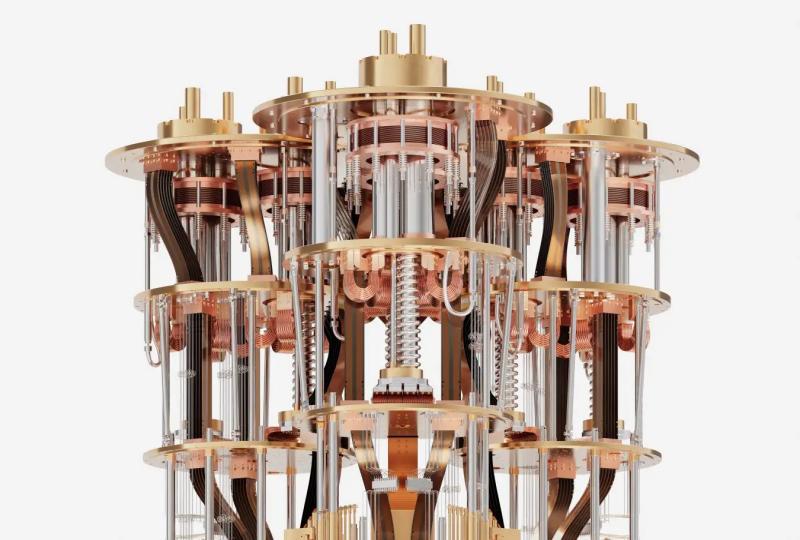
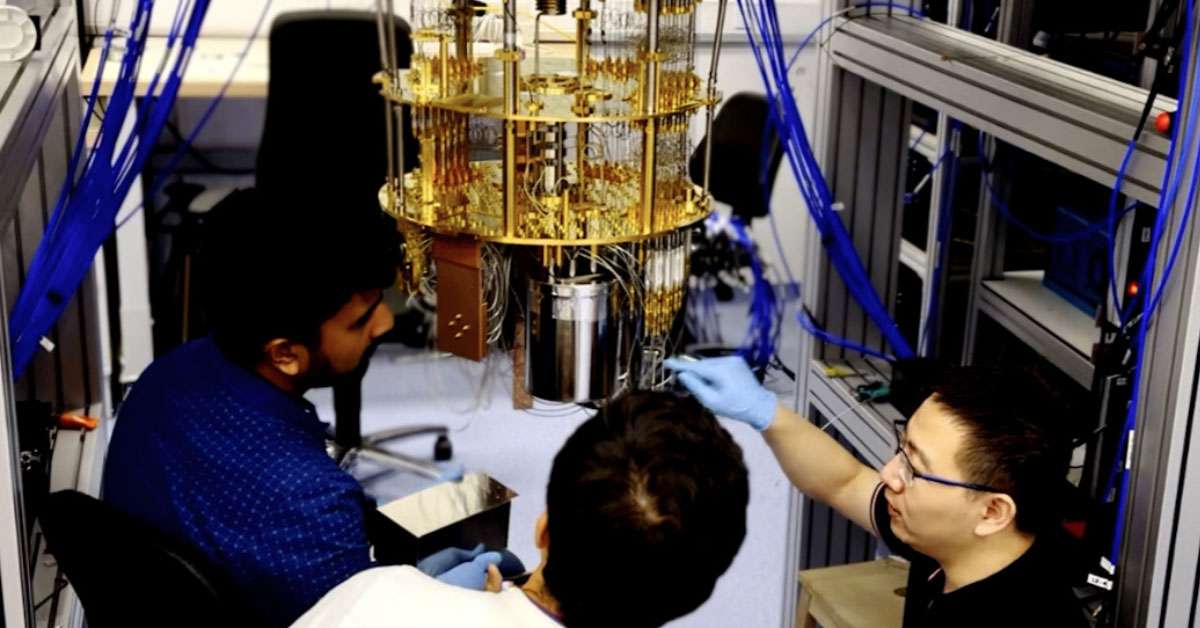
Superconducting quantum processors typically operate at temperatures in the millikelvin range. A dilution refrigerator provides the ultra-low-temperature environment required for stable quantum operations.
As processors become larger, the cryogenic system must accommodate additional cables, connectors, filters, and other components.
Each component can contribute to thermal loading. If the heat generated or transferred into the system exceeds the refrigerator's cooling capacity, the processor may not maintain its required operating conditions.
Thermal management therefore becomes an important part of scaling.
Engineers need to consider:
-
Cryogenic cooling capacity and temperature stability.
-
Heat generated by control and measurement components.
-
Cable materials, routing, and thermal anchoring.
-
Packaging and connections between the chip and its supporting electronics.
A scalable processor must be designed together with its cryogenic environment. Treating the refrigerator as an independent accessory can create integration problems as the system expands.
Calibration and Quantum Error Correction
Each superconducting qubit has its own operating parameters, including resonance frequency, control pulse requirements, and readout characteristics.
As the qubit count increases, calibrating and maintaining these parameters becomes more complicated. Small changes in operating conditions can affect gate performance and measurement accuracy.
Automated characterization and calibration tools can help researchers manage these increasingly complex workflows.
Quantum error correction introduces another important requirement. Physical qubits are vulnerable to noise and operational errors, so practical fault-tolerant computing requires logical qubits built from multiple physical qubits.
The surface code is one widely studied approach. It uses structured arrangements of physical qubits to detect and correct errors through repeated measurements.
However, supporting quantum error correction requires more than a sufficiently large chip. It also depends on qubit connectivity, gate fidelity, measurement performance, control precision, and the ability to run repeated error-correction cycles.
Therefore, increasing physical qubit counts is only one step toward building useful logical quantum processors.
How Can Engineers Make Superconducting Quantum Computers More Scalable?
Addressing these challenges requires improvements at multiple levels of the system. Several engineering approaches are particularly important.
Modular Quantum Chip Architecture
A modular architecture organizes the processor into structured units instead of treating the entire chip as one increasingly complex design.
This approach can make chip development, fabrication, testing, and system integration more manageable.
For example, a two-dimensional lattice provides a structured arrangement of qubits and couplers. Engineers can design the connectivity around the requirements of quantum operations and error-correction experiments.
Modular design also supports more systematic development. Individual components can be characterized and optimized before being integrated into a larger processor.
Our article on superconducting quantum chip architecture explains how modular design can support processor development and system expansion.
Scalable Quantum Control and Measurement Systems
A larger processor needs a control system capable of generating, distributing, and measuring signals across many qubits.
Modular quantum control and measurement electronics can help researchers expand system capacity by adding compatible hardware units.
FPGA-based processing is another useful approach. It enables certain signal-generation and data-processing tasks to be handled directly in hardware, reducing unnecessary communication with the host computer.
An effective control system should provide:
-
Precise microwave signal generation.
-
Reliable synchronization between channels.
-
Accurate qubit readout.
-
Efficient signal processing.
-
Support for automated characterization and calibration.
These capabilities help researchers manage larger processors without making every experimental operation more difficult.
Improved Signal Routing and Readout Design
Signal management becomes increasingly important as the number of qubits grows.
Engineers can improve scalability by optimizing cable routing, reducing unwanted electromagnetic interactions, and using suitable multiplexing methods.
Readout design also matters. Efficient measurement architectures can help reduce the number of physical connections required while preserving the accuracy needed for quantum experiments.
These improvements must be evaluated together. A control architecture that reduces wiring complexity is only useful if it maintains the signal quality and measurement performance required by the processor.
Automated Calibration and System-Level Integration
Manual calibration becomes increasingly time-consuming as processor size increases.
Automated tools can help characterize qubit frequencies, optimize control pulses, measure gate performance, and identify changes in system behavior.
System-level integration is equally important. Chip design, cryogenic engineering, control electronics, and software should be developed with compatible interfaces and operational requirements.
When these components are planned together, researchers can reduce integration difficulties and create a clearer path for future upgrades.
Why Does System-Level Integration Matter for Quantum Computing Scale-Up?
A superconducting quantum processor is only one part of a complete quantum computer. Its performance depends on several supporting systems working together.
A typical superconducting quantum computing platform includes four major layers.
Quantum Processing Unit
The QPU contains the superconducting qubits and the circuits used to perform quantum operations.
Its topology, coherence time, gate fidelity, and coupling architecture directly affect the processor's capabilities.
As the system scales, the QPU must provide a suitable physical foundation for more complex circuits and quantum error-correction experiments.
Cryogenic Infrastructure
The cryogenic system maintains the extremely low temperatures required for superconducting operation.
Its cooling capacity, temperature stability, and wiring configuration must match the requirements of the processor and its supporting electronics.
Quantum Control and Measurement Electronics
The control system generates the signals used to manipulate qubits and collects the signals needed to measure their states.
As the processor expands, control electronics must support more channels while maintaining synchronization, precision, and measurement reliability.
Quantum Software
Software connects the hardware with experimental workflows.
It allows researchers to configure circuits, execute operations, collect measurement results, and manage calibration procedures.
The software layer also helps coordinate different hardware components, making it easier to operate and evaluate the complete system.
These layers cannot be optimized independently. A larger QPU may require changes to the control architecture, cryogenic setup, and software workflow. System-level integration ensures that improvements in one area do not create new limitations elsewhere.
How Is SpinQ Supporting the Scale-Up of Superconducting Quantum Computers?
At SpinQ, we approach superconducting quantum computing through coordinated development of quantum processors, control electronics, and integrated computing systems.
Our product portfolio addresses several of the engineering requirements involved in building and operating superconducting quantum platforms.
.jpg)
SPINQ QPU C Series
The SPINQ QPU C Series is designed for superconducting quantum computing development and research.
Its enhanced two-dimensional lattice topology supports improved qubit connectivity and provides an architecture designed for high-density integration of up to 100+ superconducting qubits.
The platform also supports surface-code quantum error-correction architectures with code distances of up to d = 7, providing a foundation for multi-level error-correction experiments.
Different configurations address different research requirements. For example, the C5 uses a one-dimensional chain topology, while the C25 PRO uses a two-dimensional lattice.
These options allow research teams to work with different processor configurations when evaluating qubit performance, connectivity, and quantum computing architectures.
SPINQ QCM System
The SPINQ Quantum Control and Measurement System provides the electronics required to control and measure superconducting qubits.
Its modular architecture supports system expansion, while FPGA-based hardware acceleration helps process signals and generate control waveforms efficiently.
The system is designed to support the measurement and control of hundreds of qubits, with capabilities for qubit characterization and calibration.
These functions are important when researchers need to manage increasing numbers of control channels and maintain consistent experimental conditions.
SPINQ Taurus Superconducting Quantum Computer
The SPINQ Taurus superconducting quantum computer integrates multiple hardware and software components into a complete platform.
Its architecture brings together:
-
Superconducting quantum processing units.
-
Millikelvin cryogenic infrastructure.
-
Quantum control and measurement electronics.
-
Quantum programming software.
This integrated approach helps research institutions and industry users work with superconducting quantum hardware without treating each subsystem as an isolated project.
For organizations developing quantum computing research capabilities, the availability of coordinated hardware and system support can simplify deployment, experimentation, and future development.
Conclusion
Scaling up superconducting quantum computers is a system-wide engineering challenge. Increasing qubit counts is important, but long-term progress also depends on improving qubit quality, connectivity, signal management, cryogenic infrastructure, calibration, and quantum error correction.
The path toward larger and more capable quantum processors requires these technologies to advance together. Modular chip architectures, scalable control electronics, and integrated system design can help researchers address the growing complexity of superconducting quantum computing.
At SpinQ, we continue to develop superconducting QPUs, quantum control and measurement systems, and integrated computing platforms to support this progress. If your organization is exploring superconducting quantum hardware or planning a quantum computing research platform, contact our team to discuss your technical requirements.
.jpg)
Featured Content