
Superconducting Transistors: A Boost for Quantum Computing
2026.11.04 · Blog superconducting transistors a boost for quantum computing
Superconducting transistors could help advance quantum computing by improving low-temperature electronics, reducing control complexity, and supporting more integrated hardware architectures. Their potential value lies not in replacing quantum bits, but in making the electronic systems around quantum processors more efficient.
Superconducting quantum computers require extremely low temperatures to maintain stable qubit operation. They also depend on complex control electronics to send signals, manage measurements, and coordinate processor operations. As the number of qubits increases, managing these connections becomes a significant engineering challenge.
Superconducting transistors offer a potential way to address some of these limitations through low-temperature circuit integration.
What Are Superconducting Transistors?
Superconducting transistors are electronic devices that use superconducting materials and quantum effects to control electrical current. Unlike conventional semiconductor transistors, they operate through mechanisms associated with superconductivity.
One important physical principle behind these devices is the Josephson effect.
How Do Superconducting Transistors Work?
A Josephson junction consists of two superconducting electrodes separated by a thin insulating barrier or another suitable weak link. Under appropriate conditions, Cooper pairs can tunnel through the junction, allowing a supercurrent to flow.
Some superconducting transistor designs introduce an additional gate electrode to influence current flow.
Two relevant device types include:
-
Cooper-pair transistors: Use the interaction between charge and superconducting phase to control device behavior.
-
Josephson junction field-effect transistors (JJFETs): Explore gate-controlled Josephson devices as building blocks for low-temperature electronic circuits.
Although both use superconducting physics, their structures and intended applications are different.
How Are They Different from Conventional Transistors?
Conventional transistors use semiconductor materials to control current and form the foundation of modern electronics.
Superconducting transistors take advantage of superconducting behavior at cryogenic temperatures. Their potential characteristics include:
-
Extremely low resistance in the superconducting state.
-
Compatibility with certain low-temperature circuit architectures.
-
Potentially low power dissipation in suitable circuit designs.
-
Opportunities for integrating electronic functions closer to quantum processors.
However, superconducting operation does not mean an entire circuit consumes zero power. Switching, signal processing, and other electronic functions can still generate heat.
Why Does Quantum Computing Need Superconducting Transistors?
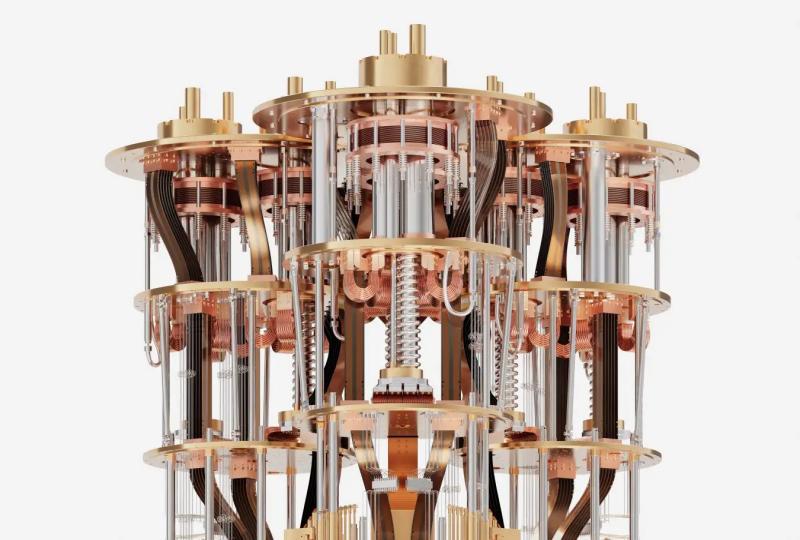
Superconducting quantum computers use qubits built from superconducting circuits. These qubits typically operate at temperatures close to absolute zero to reduce thermal excitation and protect their quantum states.
But maintaining these conditions requires more than a powerful cooling system. The electronic connections and control circuits must also be carefully designed.
The Wiring Challenge in Cryogenic Quantum Computers
Quantum processors need connections to external equipment for qubit control and measurement. These signals travel through cables, filters, connectors, and other components inside a cryogenic system.
As the processor grows, the wiring architecture becomes more difficult to manage.
Key challenges include:
-
More cables and connectors are needed for additional control and readout channels.
-
Cables introduce thermal loads into the refrigerator.
-
Limited space makes signal routing increasingly complex.
-
Maintaining consistent signal quality across many channels requires additional engineering.
Superconducting transistors could help by enabling selected control functions to operate closer to the quantum processor, potentially reducing the number of connections extending from room-temperature equipment.
Why Does Heat Management Matter?
Quantum processors are sensitive to their thermal environment. Excessive heat can increase thermal excitation and interfere with stable qubit operation.
Control electronics placed near the coldest stages of a dilution refrigerator must therefore meet strict power requirements.
Superconducting transistors may help reduce certain sources of electrical dissipation. However, the overall thermal performance still depends on circuit architecture, switching activity, and surrounding components.
How Can Superconducting Transistors Improve Quantum Computing?
The most promising applications involve the supporting electronics surrounding a quantum processor. Three areas deserve particular attention.
1. Bringing Control Electronics Closer to Qubits
Traditional quantum computing systems often place much of their control equipment outside the cryogenic refrigerator.
Superconducting transistor circuits could enable selected control functions to operate at lower temperatures and closer to the processor.
Potential benefits include:
-
Shorter signal paths between control circuits and quantum chips.
-
Reduced dependence on extensive room-temperature connections.
-
More flexible signal routing.
-
Opportunities for more compact control architectures.
This approach could become increasingly valuable as quantum processors require more control channels.
2. Reducing Power Dissipation
Power consumption is a critical consideration in cryogenic environments.
Superconducting devices may reduce resistive losses in suitable circuits, helping limit some sources of heat generation.
This could support:
-
More efficient low-temperature signal processing.
-
Better use of available cooling capacity.
-
Improved integration of electronics near quantum processors.
The actual benefit depends on the complete circuit design. Switching operations and supporting electronics can still consume power, so thermal optimization remains necessary.
3. Supporting Integrated Quantum Control Systems
Quantum computers require several electronic functions, including:
-
Signal generation and routing.
-
Multiplexing and demultiplexing.
-
Switching and signal management.
-
Readout processing.
Superconducting transistors could serve as building blocks for low-temperature logic and signal-processing circuits.
For a complete quantum computing platform, the interaction between the quantum processor and its quantum control system is essential. Both must work together to deliver accurate control signals and reliable measurement results.
Superconducting Transistors vs. Cryo-CMOS
Superconducting transistors are not the only option for improving low-temperature quantum control. Cryogenic CMOS, or Cryo-CMOS, is another important technology under development.
Both approaches aim to bring electronic functions closer to quantum processors, but they use different device technologies.
What Are the Main Differences?
Cryo-CMOS uses semiconductor transistors optimized for operation at low temperatures. It can support control and signal-processing functions in cryogenic environments.
Superconducting transistor technologies use superconducting materials and effects such as Josephson tunneling.
Their main differences include:
-
Operating principles: Semiconductor transistor behavior versus superconducting device physics.
-
Circuit design: Different approaches to switching, signal processing, and integration.
-
Power characteristics: Both require careful evaluation of power dissipation under cryogenic conditions.
-
Applications: Their suitability depends on the specific control function and system architecture.
Which Technology Is Better for Quantum Computers?
Neither technology is universally better. The choice depends on:
-
Required operating temperature.
-
Power consumption and thermal limits.
-
Signal speed and processing requirements.
-
Manufacturing maturity and integration complexity.
Future quantum computers may combine semiconductor and superconducting electronics, using each technology where it offers the greatest practical advantage.
What Challenges Must Be Solved Before Wider Adoption?
Despite their potential, superconducting transistors still face several engineering challenges.
Manufacturing and Device Consistency
Large-scale circuits require devices with predictable electrical characteristics. Manufacturing variations can affect circuit performance and make integration more difficult.
Circuit Integration and Reliability
A promising individual transistor does not automatically translate into a reliable integrated circuit. Multiple devices must operate together consistently under cryogenic conditions.
Thermal and Signal Compatibility
Even low-power superconducting circuits must meet strict thermal requirements. They must also work with quantum processors, readout components, and existing control equipment.
These challenges require coordinated development across materials, device fabrication, circuit design, and complete quantum computing systems.
The Future of Superconducting Transistors in Quantum Computing
Superconducting transistors could become valuable components in the development of more integrated quantum computing electronics. Their potential contributions include:
-
More compact cryogenic control circuits.
-
More efficient signal routing and processing.
-
Reduced dependence on extensive external wiring.
-
Better integration between quantum processors and supporting electronics.
However, they cannot independently solve every quantum computing challenge. Qubit coherence, gate fidelity, quantum error correction, chip fabrication, and system integration remain essential to building scalable quantum computers.
At SpinQ, we focus on developing superconducting quantum computing hardware, including superconducting quantum chips and complete quantum computing systems. Progress in supporting electronics is an important part of the broader effort to improve quantum hardware performance and integration.
Superconducting transistors represent one promising direction in this development. Their long-term impact will depend on how effectively they can be integrated into reliable, low-power cryogenic control architectures.
If you are exploring superconducting quantum computing hardware or system integration, contact our team to learn more about SpinQ's solutions.
.jpg)
Featured Content